Beware the hooks! AuDHD and ADHD’s influence on thought
The irony of these hooks is that they don’t seem to align with an attention deficit at all, quite the opposite. I might argue that “attention deficit” is really what it looks like to somebody who has noticed but not accepted they are boring me to tears.
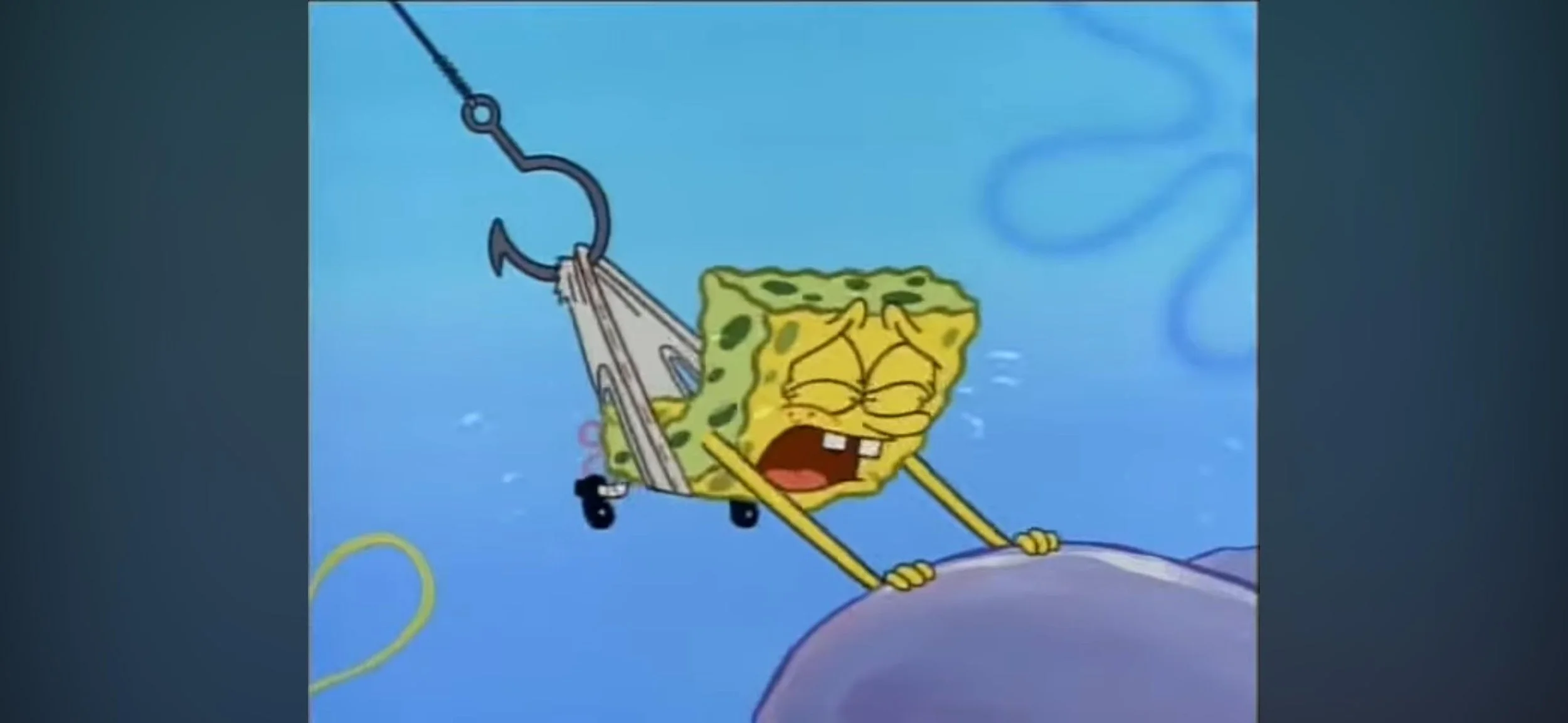
Spongebob: Ep. Hooky
How many other people with AuDHD or ADHD have felt themselves unable to let go of a stream of thought? It happens to me frequently. I feel like a dog with a chew toy, I just cannot let go, even after a good mangling.
I never even realized this is what I was doing until I’d been “consistently” on my meds. At this point, I have to conclude my academic curiosities and my enjoyment of a good critique or debate are a result of these hooks that just won’t let go of a topic. The irony of these hooks is that they don’t seem to align with an attention deficit at all, quite the opposite. I might argue that “attention deficit” is really what it looks like to somebody who has noticed but not accepted they are boring me to tears.
The upside to these naturally occurring hooks is that I can get quite deep into some interesting topics and experience the satisfaction gained from new perspectives and a deeper conceptual understanding. However, the downside is no joke. These hooks can get into streams of thought that are not productive, fed and exacerbated by anxiety and depression. Those with AuDHD and ADHD have often been noted to have a creative bent due to lateral thinking and an intimidating imagination, but if that machinery is hijacked by anxiety, my mind is then in that place for the foreseeable future.
Before I was diagnosed, I always used to say things like, “I have a lot on my mind,” or, “I wish I had an off button” when talking about the difficulty of quieting my thoughts towards the end of a day. I don’t know how many times I have tried to guide a thought process to a natural full stop with the hopes of freeing my mind from this burden, but it never seems to work. Given that often what I am doing is trying to make predictions and come up with contingency plans for different eventualities, I can sometimes accept that I simply cannot know and therefore should put the thought process on hold until I know more. I can also accept that my mind likes to spear ideas with hooks, reminding me that this is in my nature, which can perhaps help keep the emotional response in check (if my alexithymia hasn’t blinded me completely). So far, though, the best solution seems to be distraction – spear something else.
I have also noticed my hooks can be sensitive to communications from others, which result in something being said (written), and I’m unable to gauge meaning or intention (the Au in AuDHD). My response, and I don’t have much say in this, is to sink my hooks into the message and figure out both what it meant and what it means in the context of understanding my future. I usually have to remind myself that I am going to over-think it, there might not be much meaning or intent, and even if there is, it’s just one opinion. Although, to save myself from any mental acrobatics that might ruin my evening, I tend to avoid communications towards the end of the day and tackle them in the morning – I know avoidance isn’t a great solution, but I’m still waiting for the day when everyone gets their communication out the way in the morning, so they can then shut up for the rest of the day.
The Milestone in Mental Health
My stake in the mental healthcare discussion is similar to everyone else’s. After half a lifetime of experiences that never quite made sense, things started to click and I was late-diagnosed with ADHD, although I think I’m more AuDHD. Mental healthcare is now a staple of popular media, millions of Internet users discuss it every day, and there has been a rise in activism to push for changes in the shared aspects of our world to accommodate for everyone. This might be a fire that needs to rage if we are to achieve the stubbornest of all civic goals, systemic change, but are we missing something more fundamental?
In this age of constant fighting, where everyone at a moment’s notice has to be prepared to cling-on to their rights, one can’t help thinking we’ve reached a moment in time for a much needed paradigm shift in terms of how we see each other. The wealth gap is eye-wateringly askew, willful planetary destruction coupled with climate change threatens our survival, and governments have inverted, to now be run by naïve ideologues obsessed with stripping all meaningful public services. It’s not surprising this is also the age that the contrived service of “AI” has been foistered on everyone as its core principle is to remove the person from exercising skillsets, although talking points mask this by marketing it as the removal of chores/inconveniences/thought; purveyors of lobotomies once promised the same thing. Chores and inconveniences are still needed to build us as humans – to remove them will make us less human and incapable of the oversight we are supposed to provide over the AI slop produced in our place.
From the outside, it looks like we are living in a fundamentally antihuman era.
With this background, it is not surprising that mental health is on everyone’s lips. One of our strongest pillars for maintaining control of our mental health is to believe that we have a future and it will be better than what we endure in the present. Maintaining this belief starts to become untenable if our standard of living drops and the world seems to be slipping into chaos.
In addition to these environmental factors, everyone remains at the mercy of their biology, something compounded in the US by struggles with health insurance companies. Our brain health can still be undermined by strokes, aneurysms and embolisms, cancer, Parkinson’s Disease, Huntington’s Disease, Alzheimer’s Disease, and Amyotrophic Lateral Sclerosis, etc. These maladies can impact memory, mood, and personality, if not directly then consequently. A decline in brain health impacts how a person can interact with the world around them and how they have traditionally thought about everything they do and everything they are.
Mental health is a concept premised on the idea that should something be wrong with our minds, we should seek to correct them back to a healthy state of normal. A problem with this idea is that the passage of time, combined with the impact of aging, means returning to a prior state is impossible and the concept of normal quickly becomes a mirage. Normal is a state of mind, once held, that provides a sense of peace and security. When it comes to how we see our health, normal is the security blanket we all crave, and we are sometimes prepared to pay for with defiance. Normal also stops us from recognizing and appreciating difference.
When it comes to brain health, unfortunately there isn’t a lot of utility in talking about what should be. What should be is the question behind systems of morality, law, and justice, so as a line of questioning it is natural for people to think this way. If a brain develops a tumor, the resultant tumor was due to the complexities of human biology, and the oncologist is tasked with removing the tumor and preventing recurrence. They can rightly assume this is a state of brain health that should result in the best outcome for the patient, but should bes are human judgments and attempts at wish fulfillment over complexities that can only be minimally influenced.
Neuroscience has also shown us that common mental health disorders are indicative of unique pathologies, literally meaning that the brains of autists and those with classical personality disorders pursued their own unique development that differs from those without these conditions. Changes are often found in gray and white matter volumes, white matter conductivity (resting and during activity), and gyrification (the amount of folding in the neocortex). But again, these complex and enduring pathologies are not changing course from some ideal, they just are. Human.
To be human and living in the world means we are all united by the same risks to our mental health, even if our desire to see ourselves as normal and healthy prevent us from empathizing with those vocal about their struggle. Disorder and disease are not outside forces looking to infiltrate our bodies, they reflect how our bodies have developed within the complex rubric of gene-environment interaction and how our bodies are responding to life around them; they are all part of what it is to be human, even though our knowledge and technologies have allowed us some influence in these areas to better understand how we can live.
This means that the quest for a compassionate society might not be best served by a multitude of advocacy groups, all competing with their own interests, and quick to be ignored by those who cannot currently identify or use it to turn a profit. An understanding and acceptance of our human nature, as it rightfully applies to all, might be the milestone we need to move forward.
Should we even be using our voices with voice-activated assistants?
The voice is precious and easily taken for granted.
First published on the Art of Autism blog, 09/24
The thought of using my voice to request certain functions through such assistants as Alexa, Siri, or Google Assistant has always struck me as weird and a bit awkward. I am not talking to them, after all, I am activating them. For somebody who is neurodivergent and introverted, the need to use my voice in an additional context is aggravating, not in the least because the differences between talking and activating will wreak havoc on what I feel I am supposed to do or how I am supposed to interpret responses.
The voice is precious and easily taken for granted. Toddlers begin to use it to receive the attention of parents and caregivers; a heart-melting and profound moment for all involved. The voice is an expression of yourself that others become familiar with and learn to associate your sound with your personality and presence. The voices of those we are attracted to can turn us into a nervous wreck or melt us like butter. When a familiar and cherished voice has been absent for long enough, we start to yearn to hear it again.
There is a complex neurobiology behind using the voice. Much of our parietal lobes are involved with interpreting sounds and gaining meaning so that we can then go on to express ourselves within these contexts using other language centers like Broca’s and Wernicke’s areas. Conversation and the use of the voice strikes deep into who we are and what we think, and so when we do use it the potential for connection and relationships with others increases exponentially.
However, given the neurobiological complexity, using one’s voice can take its toll on one’s energy levels. Some conversations can be exhausting and sometimes after extensive voice use, there is the desire for an extended period of solitude. This might explain why many prefer a texting conversation rather than actual talking because there is greater control over energy expenditure. Sometimes people do not want to have to summon the strength for voice use, especially when they are in the home and wish to relax.
When we use our voice we automatically make assumptions about who might be listening and use them to guide which words we choose and how we deliver them. Voice activated assistants do not have minds or personalities, and so some of the work your brain starts to do in anticipation of talking is wasted and unnecessary. The use of the voice with a voice activated assistant, can therefore feel like recruiting a surgeon to apply a band aid.
Using the voice as a switch feels like cheapening ourselves.
The voice has energy requirements and so it is a limited, and therefore a precious resource. The voice activated assistants do not care about you and are only concerned with listening, keeping a record of the functions you request, and providing you with information that will take more of your money or more of your time, and you have to use an integral part of yourself to get any use out of it.
I, personally, am yet to be convinced that voice activated assistants are worthy of our voices. If we need noise to do things for us, clapper technology is fine.
What is currently missing from the neurodiversity movement
As with all social movements, messaging about systemic change or requests to understand or acknowledge a person’s pain will not last long within popular messaging. These things cannot be marketed and will not result in an immediate profit, in fact they will cause an immediate loss. Systemic change to address the root cause of neurodiverse suffering would require new business models and ways of working that permit the neurodiverse to work in ways that assist them.
There is a notable absence of empathy within the booming neurodiversity and mental health market in general and that is a reluctance to accept that some people do not want to move away from their pain or they want to do it on their own terms. This essay intends to demonstrate how the messaging within the neurodiversity movement from publishers and advocates might not appeal to the neurodivergent, as it lacks any real attempt to understand and communicate their pain.
Two of the biggest book publishers that openly publish neurodivergent books are solely involved in positive narratives, stories of acceptance and overcoming, and guides to living as neurodivergent. The message, therefore, is about change and transition to an ideal created by other people. Adults, particularly those who were late diagnosed, will have spent time reflecting on pain and grievances experienced throughout their entire life (Lupindo et al., 2023). This is personal to them, these experiences have shaped who they have become, and so literature that is asking them to accept an ideal that was based on somebody else’s experience might not appeal to them; from a business perspective, this is isolating a key section of the market. However, negative narratives and aversive experiences might be of greater appeal because they do not claim there is something better and do not beggar the need to change – in other words, there is an honesty to them and they are more relatable. There is power in knowing that other people have had similar experiences, which leads to solidarity and community (think the ‘Me too’ movement).
The neurodiversity movement has gained enough of a foothold now that businesses that have historically been reluctant to recruit and promote the neurodiverse (Austin & Pisano, 2017) are now willing to use its language (Krzeminska et al., 2019), there is now a flourishing market for memoir and self-help from neurodiverse perspectives, and neurodiverse influencers (whether neurodiverse or not) can eke out a living. The neurodiversity dollar has become lucrative, which on the one hand means there is more neurodiversity messaging to more people, but on the other hand this type of messaging will have to be protected to assure profitability.
This means the common messaging is likely to remain the same. Stories about a person’s life struggle and how they overcame adversity will be extremely popular. Messages about perceptual differences between the neurodiverse and neurotypical can be played for both education and comedic effect. Days can be put aside to flaunt colored ribbons and donuts can be brought into the office. 5Ks can raise money for the cause. In fact, marketing is often intimately related to hope (MacInnis & Chun, 2007) All of this is good for business without really having to do anything that genuinely addresses the grievances of the neurodivergent (there is no attempt to understand or empathize with personal pain and no mention of plans to design a new business model to address neurodivergent ways of working).
As with all social movements, messaging about systemic change or requests to understand or acknowledge a person’s pain will not last long within popular messaging. These things cannot be marketed and will not result in an immediate profit, in fact they will cause an immediate loss. Systemic change to address the root cause of neurodiverse suffering would require new business models and ways of working that permit the neurodiverse to work in ways that assist them. Experiencing the pain of others through an empathic response is by its nature a willful act of feeling bad, which conflicts with the do-gooding nature of the cause. This means the neurodiversity movement runs the risk of being relegated to a banal industry that allows a handful of individuals to turn a profit.
The level of understanding and education required for legitimate change often proves too much and there is no money to be made in trying, and so we are left with the same sometimes humorous sometimes educational, but always censored and saccharine messaging.
This can be problematic if there is intent within the messaging to share advice, as what we tend to find is advice with no understanding. In the context of strangers meeting, and one person reading a brief description of the other’s issues, there is not enough information to then proceed with advice or a solution. Neurodivergent people have often stated time and time again that they feel misunderstood (Beck et al., 2024; Pavlopoulou et al., 2025; Banks et al., 2024) Without knowing a person or the series of events that led to the description of the problem, advice should not be forthcoming unless asked. There is a cost to offering advice when the topic is as personal as somebody’s life, and the cost is investing time and understanding on a 1:1 basis. If issues are shared by somebody for the first time, there is a strong possibility the person is looking for recognition and solidarity instead. Offering advice in this context could insult the intentions of the person sharing their issues.
If we do not want to feel the pain of others and we want to offer our advice with no understanding (things that are currently fostered by popular neurodiversity messaging), how can we ever really understand the pain of the neurodivergent?
Our willingness to understand the pain of others remains a crucial question within our collective morality. This is not a comfortable place to be. Depression and anxiety are contagious (Abdelhadi et al., 2025; Joiner & Katz, 1999; Huang et al., 2024). One reason that we should all take a moment to celebrate good therapists is that they have opened themselves up to endure the pain of others despite the mental and emotional challenge. Advice and help come with a toll; if you want to provide them, you need to put the work and time in first, in much the same way that parents of young children are loathe to take advice from people who have no children. However, the answer is simple. Instead of offering advice, offer understanding and solidarity.
The pain of others can be remarkably complex.
If a person has endured a life of pain and suffering, in all the myriads of ways that those things are possible, it will have shaped who they are, how they think, and how they respond to others in the present (Schwaller & Fitzgerald, 2014). When observing pain and suffering in others there can be a well-intentioned drive to try to help and try to lessen their experience of these negative emotions. If the person is experiencing immediate threats to their survival and are openly pleading for help, a response is perhaps obvious – help them to get away from danger. But if there is no immediate threat but they have a long and complicated history of negative experience, a lot more time and effort is required to get to know the person (and only if they want to get to know you).
For the person who has endured a life of pain and suffering, even if they are trying to minimize those experiences in the present, so much of what they know about life and living has been learned through their painful experience. A study in the UK that used data collected over 40 years found that those diagnosed with an internalizing disorder (anxiety or depression) in adolescence had an odds ratio of 9.5 times more likely to have a mental disorder in adulthood compared to those adolescents with no internalizing disorder (Colman et al., 2007). Pain stays with them and becomes a part of their pathology.
This can ironically cause a repetition of pain and suffering because those things form a strong part of what the person knows about themselves (Bowins, 2010). In addition, it is not uncommon for humans when developing a familiarity with their circumstances to create schemas, plans for enduring adversity and coping mechanisms, to function during such times. This means that if pain and suffering are common, the schemas and ways of dealing with life will have been heavily informed by the pain and suffering (Riso et al., 2006).
However, it doesn’t stop there. Pain shapes us. It trains us. And we end up in a relationship with it (we use attention and emotion to modulate our pain: Coghill et al., 1999). If our pain defines us, it is conceivable that we might not know who we are without it. Pain then becomes instrumental in how we see and maintain ourselves. This phenomenon has been well documented throughout history when exploring sadomasochism. The necessity for pain is achieved either by inflicting or receiving pain with others or inflicting it on oneself. The relationship a person has with pain should be of concern to any therapist, especially if there is the possibility of violence against others or themselves, but a person’s relationship to their pain need not be tied to violence.
A life with (at least) periodic depression and questions of self-worth are also likely to encourage questions about individual existence (as the person sees themselves an ill-fit for the world) and thoughts of death. These thoughts do not have to be planning suicide or suicidal ideation, but thought experiments to discover their worth in life. Thoughts of death quickly become metaphor for absence of friends, family, or meaningful relationships; it can also symbolize the person’s failure (to themselves) of trying to “fit in” or function in society. As these thoughts persist, thoughts about death could become a key part of coping mechanisms. For example, the neurodivergent often experience sensory overload (Strömberg et al., 2022), which can lead to burnout, and the extended need for sensory deprivation and solitude. To retreat to a quiet and dark place to rest mirrors the act of dying; living, by contrast, can be seen as the toleration of sensory input. If death has already been a common thought, pairing it with the need for rest due to its similarities will start to welcome more of these death-related thoughts. Resting from burnout is strongly welcomed by the neurodivergent and so thoughts of death become associated with good feeling. This does not necessarily mean they want to die or commit homicidal behavior, rather there is the interest in the macabre, such as enjoying vampire-themed stories, celebrating Halloween, or coping with anxiety by watching horror movies. There is also the embrace of goth culture, by the neurodivergent (Whalen, 2024) and goth metanarratives explore themes of loss, absence, and marginalization, and a common notion within goth culture is to romanticize the idea of becoming a supernatural being isolated from a fearful society, which treats them as a monster (van Elferen & Weinstock, 2015). Whether it is intentional or coincidental, goth culture, then, takes the negative experiences of the neurodivergent and thoughts about death and funnels them into a community with group acceptance.
Ironically, thoughts of death then help the person to live.
Understanding and explaining this complexity about neurodiversity is currently not addressed in neurodivergent literature or books and is certainly not acknowledged in company messaging.
Neurodivergent people deserve better from groups claiming to represent them. Adult neurodivergent fiction that showcased neurodivergent thought processes through narrative would both educate and entertain. Detailed explanations of coping mechanisms to deal with a difficult world would be enlightening, even if it did make readers squeamish. Yes, there are success stories, but neurodiversity through poor mental health and no support systems also destroys people. These messages are just as important.
Publishers and neurodiversity advocates that claim to care about the people they represent need to make greater efforts to get to know, understand, and communicate the pain of the neurodiverse. If they did this, the personal depth of the neurodivergent would help to give them a more diverse catalogue, expand their market, and help the neurodivergent to feel better represented.
References
Abdelhadi, I. A., Mohammed, O. A., Babikir, S. K., Bedri, E. A. M. A., & Abdelhadi, A. A. (2025). Is mental health contagious? Depression, anxiety, stress and burnout among Mental health professionals in Sudan. BMC psychiatry, 25(1), 148.
Austin, R. D., & Pisano, G. P. (2017). Neurodiversity as a competitive advantage. Harvard Business Review, 95(3), 96-103.
Banks, A. L., Mainess, K. J., Javaherian, H., & Natsuaki, M. N. (2024). “Very Misunderstood”: Self-Perceived Social Communication Experiences of Autistic Young Adults. Youth, 4(4), 1628-1646.
Bowins, B. (2010). Repetitive maladaptive behavior: Beyond repetition compulsion. The American Journal of Psychoanalysis, 70(3), 282-298.
Beck, K. B., MacKenzie, K. T., Kumar, T., Breitenfeldt, K. E., Chang, J. C., Conner, C. M., ... & Mazefsky, C. A. (2024). “The world’s really not set up for the neurodivergent person”: Understanding emotion dysregulation from the perspective of autistic adults. Autism in Adulthood.
Coghill, R. C., Sang, C. N., Maisog, J. M., & Iadarola, M. J. (1999). Pain intensity processing within the human brain: a bilateral, distributed mechanism. Journal of neurophysiology, 82(4), 1934-1943.
Colman, I., Wadsworth, M. E., Croudace, T. J., & Jones, P. B. (2007). Forty-year psychiatric outcomes following assessment for internalizing disorder in adolescence. American Journal of Psychiatry, 164(1), 126-133.
Huang, C. W., Hu, T., Zheng, H., Wu, Y. L., Li, J. M., Wang, Y. M., ... & Jiang, C. L. (2024). Contagion of depression: a double-edged sword. Translational Psychiatry, 14(1), 396.
Joiner Jr, T. E., & Katz, J. (1999). Contagion of depressive symptoms and mood: Meta-analytic review and explanations from cognitive, behavioral, and interpersonal viewpoints. Clinical psychology: Science and practice, 6(2), 149.
Krzeminska, A., Austin, R. D., Bruyère, S. M., & Hedley, D. (2019). The advantages and challenges of neurodiversity employment in organizations. Journal of Management & Organization, 25(4), 453-463.
Lupindo, B. M., Maw, A., & Shabalala, N. (2023). Late diagnosis of autism: Exploring experiences of males diagnosed with autism in adulthood. Current Psychology, 42(28), 24181-24197.
MacInnis, D. J., & Chun, H. E. (2007). Understanding hope and its implications for consumer behavior: I hope, therefore I consume. Foundations and Trends® in Marketing, 1(2), 97-189.
Pavlopoulou, G., Chandler, S., Lukito, S., Kakoulidou, M., Jackson, I., Ly, E., ... & Wilson, A. (2025). Upsetting experiences in the lives of neurodivergent young people: A qualitative analysis of accounts of adolescents diagnosed with attention‐deficit/hyperactivity disorder and/or autism. JCPP Advances, e70038.
Riso, L. P., Froman, S. E., Raouf, M., Gable, P., Maddux, R. E., Turini-Santorelli, N., ... & Cherry, M. (2006). The long-term stability of early maladaptive schemas. Cognitive Therapy and Research, 30(4), 515-529.
Schwaller, F., & Fitzgerald, M. (2014). The consequences of pain in early life: Injury‐induced plasticity in developing pain pathways. European journal of neuroscience, 39(3), 344-352.
Strömberg, M., Liman, L., Bang, P., & Igelström, K. (2022). Experiences of sensory overload and communication barriers by autistic adults in health care settings. Autism in Adulthood, 4(1), 66-75.
Van Elferen, I., & Weinstock, J. A. (2015). Goth music: From sound to subculture. Routledge.
Whalen, K. M. (2024). Goth subculture, neurodivergence, and the dark power of changeling narratives. In Heavy Metal and Disability (pp. 162-178). Intellect.

Psychopaths are neurodivergent too
The Psychopathy Checklist was purely devised from understanding and observing behavior was then used in neuroscience (notability by Adrian Raine), and it was discovered that those the list determined to be psychopathic, also seem to have significant differences in various brain structure and function.
Therefore, a psychopath’s way of thinking and behaving (existing) is different to what is currently considered as normal (neurotypical). They are neurodiverse.
For many years now, neurodiversity has characteristically recognized those with autism, ADHD, bipolar, Tourette’s Syndrome, synesthesia etc. as being neurodiverse. There does appear to be some understanding that to be considered neurodiverse is not in itself a diagnosis and the term neurodiverse simply means that the person’s way of thinking and behaving (existing) is different to what is currently considered as normal (neurotypical). These are rules that have been created to justify the existence of a social movement to help improve the lives of people who traditionally have been seen as mentally disordered.
Current support and literature about neurodiversity focuses on the struggles of the neurodiverse, and in some cases their caregivers, and advocates for more understanding or provides ideas about how to exist in a world that does not seem compatible with the neurodivergent. There are stories of struggles and how they have been overcome, or in some cases, how they have not. There is resource and there is sympathy, things that would not be present without the neurodiversity movement.
However, this means that anyone who would traditionally be seen as mentally disordered can stake a claim to be neurodivergent. And it is a worthwhile claim to stake because the movement has progressed enough that the neurodiverse now have community and recognition in ways that they did not have before.
The modern study of psychopathy goes back to the early 20th century, when it was studied by Hervey Cleckley, and his thoughts and findings were published in The Mask of Sanity. Coming into to the late 1980s, Robert Hare began an exhaustive behavioral analysis of psychopathy and devised the Psychopathy Checklist, which became the gold standard for diagnosing psychopathy. This list, which was purely devised from understanding and observing behavior, was then used in neuroscience (notability by Adrian Raine), and it was discovered that those the list determined to be psychopathic, also seem to have significant differences in various brain structure and function.
Therefore, a psychopath’s way of thinking and behaving (existing) is different to what is currently considered as normal (neurotypical). They are neurodiverse.